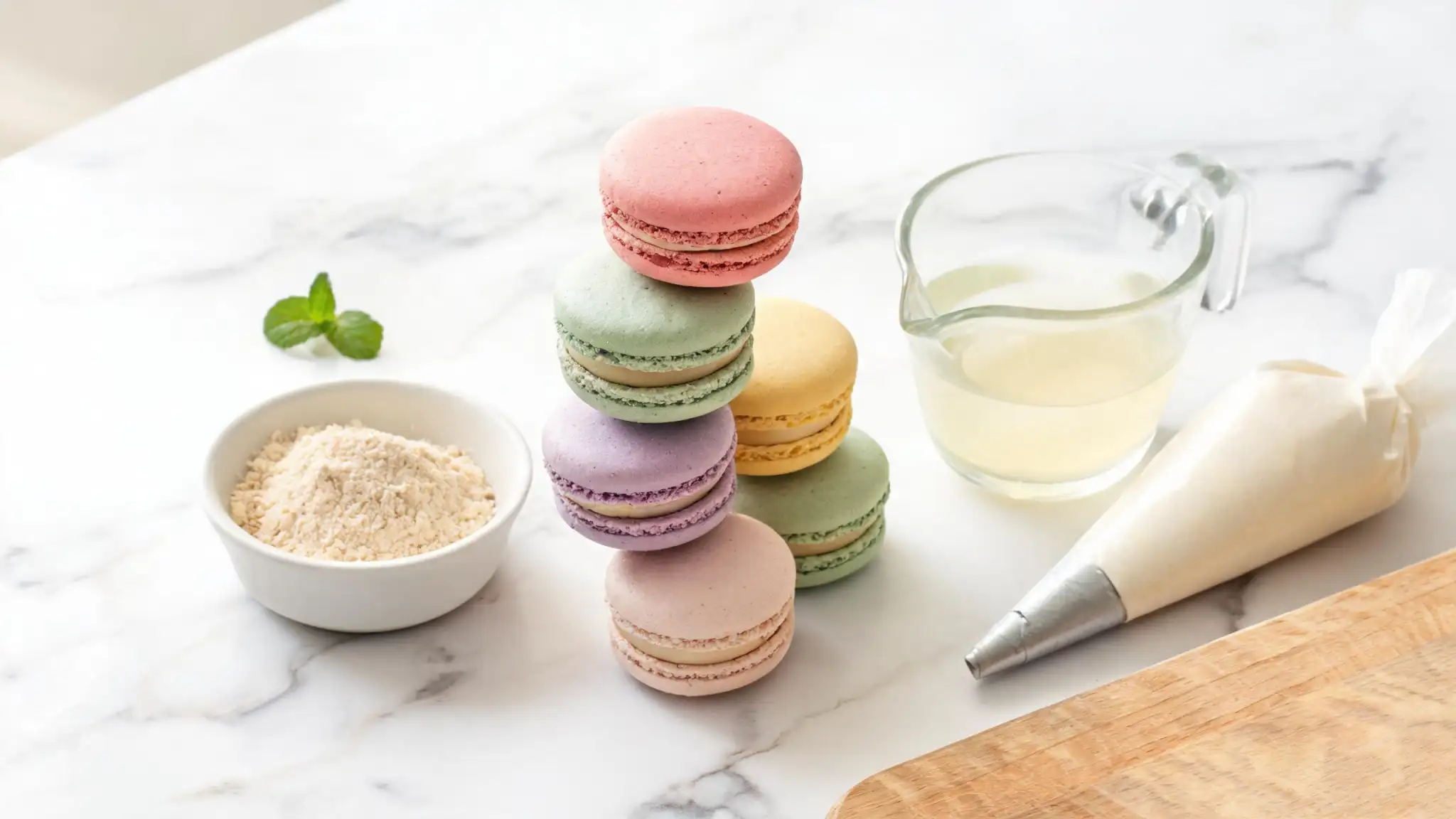
If you've ever wondered how to make French macarons at home without ending up with cracked shells, hollow bites, or a puddle of almond batter, you're in the right place. These delicate sandwich cookies have a reputation for being fussy, but the truth is that macarons are simply a chemistry project dressed up as dessert. Once you understand the ratios, the timing, and the visual cues, they become one of the most rewarding bakes in your kitchen.
This foolproof beginner's guide breaks the process into clear, repeatable steps. You'll get exact gram weights, a simple macaronage test, and a troubleshooting FAQ that covers the problems most home bakers run into first. Let's turn powdered sugar and egg whites into smooth, footed, bakery-style macarons.
What Makes a Macaron "French"?
The classic French macaron is made by whipping aged egg whites with granulated sugar, then folding that meringue into a blend of almond flour and powdered sugar. Unlike the Italian method, which cooks sugar syrup into the whites, the French method is faster, requires fewer tools, and is more forgiving for beginners—provided you measure carefully and fold correctly.
The Foolproof Ingredient List
Macarons do not tolerate guesswork. Use a digital kitchen scale and these gram weights for roughly 24 shells (12 filled macarons):
100 g almond flour (blanched, very fine)
100 g powdered sugar (confectioners' sugar)
75 g aged egg whites, divided (38 g for the meringue + 37 g added to the dry mix)
75 g granulated sugar
Pinch of cream of tartar (optional, for meringue stability)
Gel food coloring (optional; avoid liquid coloring)
If you need a nut-free version, almond flour can sometimes be replaced with finely ground sunflower seed flour, though the flavor and color will shift slightly. The U.S. Department of Agriculture's FoodData Central is a reliable place to compare the nutrition and moisture content of different flours before you substitute.
Equipment That Actually Matters
Digital kitchen scale (0.1 g precision preferred)
Electric hand or stand mixer
Stainless steel or glass mixing bowls
Fine-mesh sieve for almond flour and powdered sugar
Silicone spatula
Piping bag + round tip (about 10–12 mm / 0.4–0.5 inch)
Macaron template (printable or silicone mat)
Heavy baking sheet + parchment paper
Oven thermometer
Step-by-Step: Foolproof French Macarons
Step 1: Sift and Macerate the Dry Mix
Sift the almond flour and powdered sugar together. If you still have coarse pieces after two passes, discard them or grind them finer—large grains cause lumpy shells. Add the first portion of egg whites (37 g) to the dry mix and stir until it forms a thick almond paste. Cover and set aside.
Step 2: Make a Stable French Meringue
Put the remaining 38 g of egg whites in a clean bowl. Beat on low until foamy, then add cream of tartar if using. Gradually add the granulated sugar in 3–4 additions while increasing the mixer speed. Beat until the meringue reaches stiff, glossy peaks. When you lift the whisk, the peak should stand straight up without curling. Add gel coloring in the last 30 seconds of whipping.
Step 3: Macaronage: The Make-or-Break Step
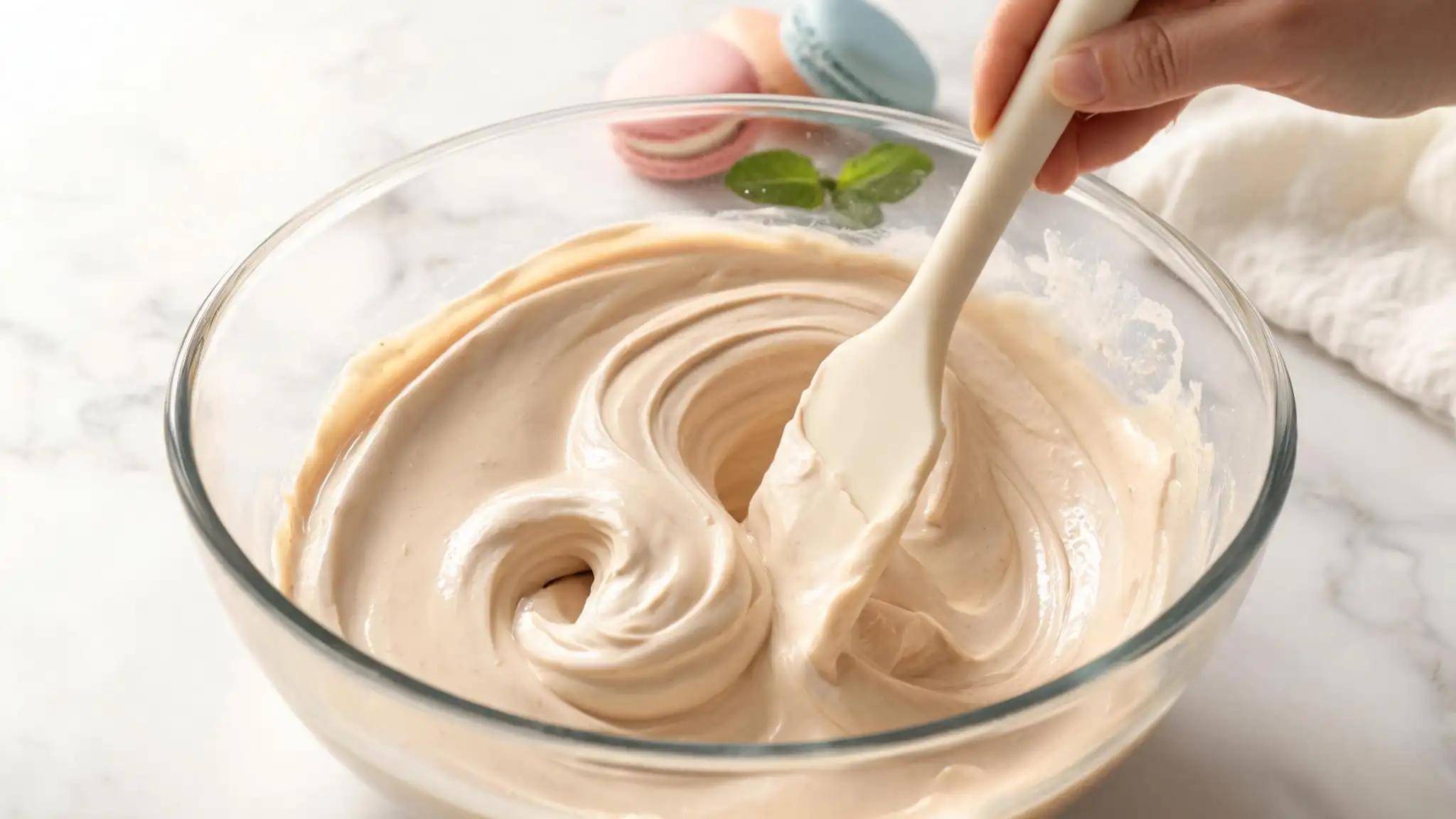
Scrape the meringue onto the almond paste. Using a silicone spatula, fold from the bottom of the bowl up and around the sides in a smooth J-motion. This deflates air while coating every almond particle with meringue. Keep folding until the batter flows like thick lava and a ribbon lifted from the bowl disappears back into the surface within 20–30 seconds.
The classic test is the figure-8 test: let the batter flow off the spatula and draw a figure 8. If the batter breaks or breaks apart before finishing the 8, fold 2–3 more strokes and test again. If it spreads instantly and loses its shape, you've gone too far.
Step 4: Pipe and Rest
Transfer the batter to a piping bag fitted with a round tip. Pipe 3.5–4 cm (1.4–1.6 inch) circles onto a template-lined baking sheet, holding the tip perpendicular to the sheet and stopping pressure before lifting away. Rap the tray firmly 2–3 times against the counter to release trapped air bubbles. Pop any visible bubbles with a toothpick.
Let the shells rest at room temperature until a skin forms—the tops should look matte and feel dry to a light touch. Depending on humidity, this takes 30–60 minutes. Preheat your oven to 150 °C (300 °F) while the shells rest.
Step 5: Bake and Cool
Bake one sheet at a time on the middle rack. A good starting point is 150 °C (300 °F) for 14–16 minutes, but ovens vary. The shells are done when the tops are firm and the feet look set but not browned. Slide the parchment onto a wire rack and cool completely before peeling the shells off. Warm macarons will stick; patience here is not optional.
Step 6: Fill and Mature
Pair shells by size, pipe your filling (buttercream, ganache, or jam) onto one shell, and sandwich with another. Store filled macarons in an airtight container in the refrigerator for 24–48 hours. This maturation period allows the filling to soften the shells slightly and blend the flavors. Bring them to room temperature for 15–20 minutes before serving.
Pro Tips for Beginner Success
Age your egg whites for 24–48 hours in the fridge, then let them come to room temperature. Aged whites whip more consistently.
Weigh everything, including liquids. Volume measurements are the fastest way to fail a macaron recipe.
Keep humidity low. Rainy days make resting take forever; use a dehumidifier or air conditioner if needed.
Don't over-mix during macaronage. Under-mixed batter can be fixed; over-mixed batter cannot.
Use an oven thermometer. Most home ovens run 5–15 °C hotter or cooler than the dial says.
For extra food-safety context, especially when working with raw or partially cooked egg whites, review the FDA guidance on egg safety.
Troubleshooting FAQ
Why are my macarons cracked on top?
Cracked tops usually mean the shells didn't rest long enough to form a skin, or the oven temperature was too high. Let the piped shells rest until matte, and try lowering the oven temperature by 5–10 °C while adding 1–2 minutes of bake time.
Why do my macarons have no feet?
Macarons rise because steam pushes upward through a dry top skin. No feet usually means the meringue was under-whipped (too soft), the batter was over-mixed and runny, or the oven temperature was too low. Aim for stiff meringue peaks and a thick-lava batter consistency.
Why are my macaron shells hollow?
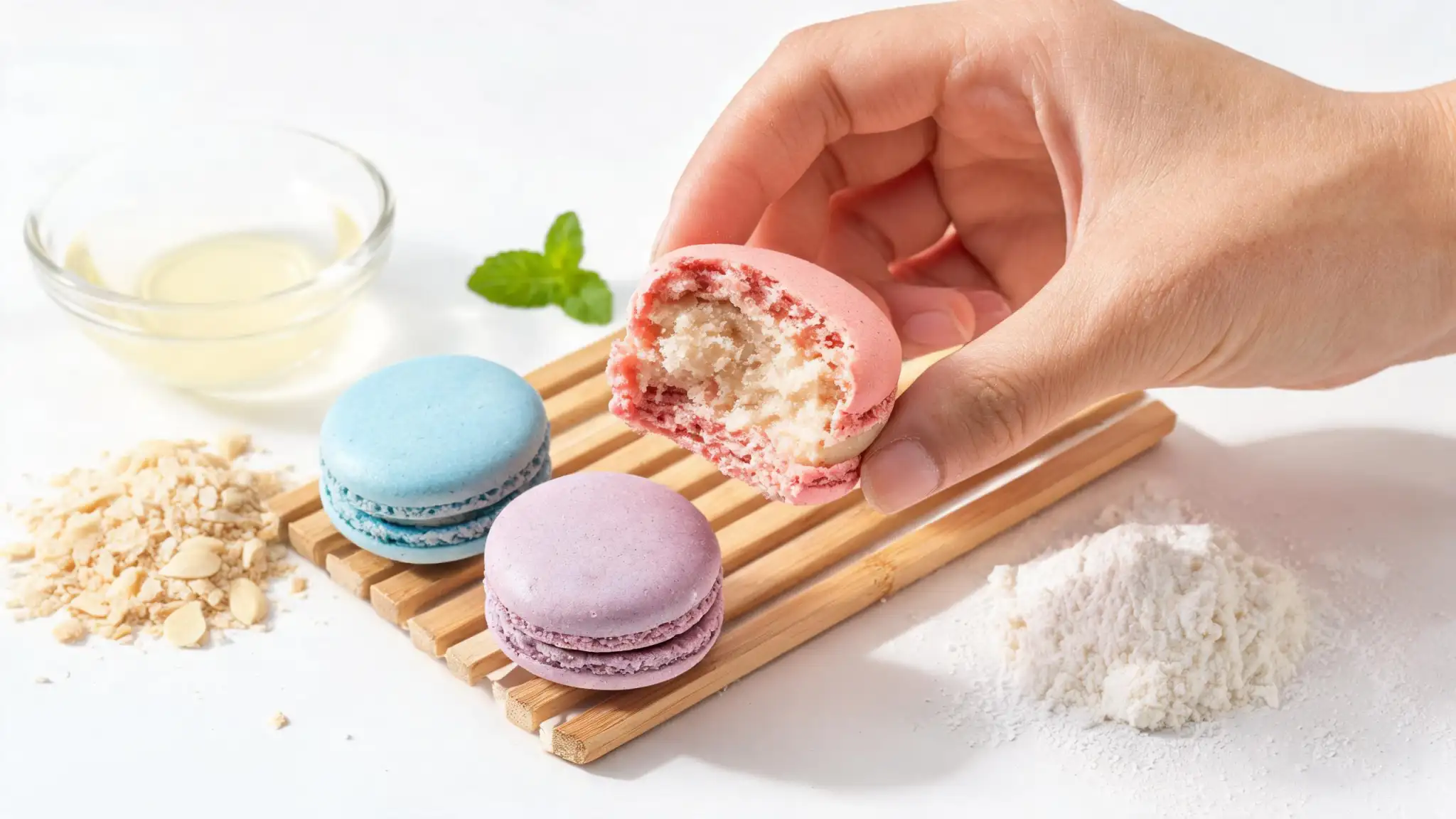
Hollow shells are most often caused by over-mixing (too much air lost) or over-baking. Pull the shells from the oven as soon as the tops are firm and the feet are set, then cool completely before removing from the parchment.
Why is my batter too runny to pipe?
Runny batter is almost always over-mixed macaronage. Next time, stop folding earlier and rely on the figure-8 test. You can sometimes rescue slightly over-mixed batter by letting it sit for 5 minutes to thicken, but heavily over-mixed batter is best discarded.
Can I use carton egg whites for macarons?
Pasteurized carton egg whites can work, but they often whip more slowly and to a softer peak than fresh aged whites. If carton whites are your only option, add a pinch of cream of tartar and whip a little longer.
How long do homemade macarons last?
Filled macarons keep in the refrigerator for up to 5 days in an airtight container. Unfilled shells can be frozen for up to 1 month. Always bring them to room temperature before serving so the texture is chewy rather than hard.
Take the Guesswork Out of Baking with CookGo
French macarons are worth the effort, and they become far easier when you have a recipe companion that converts units, scales ingredients by serving size, and keeps your timers in one place. Discover more step-by-step guides and smart kitchen tools on the CookGo website and app.